HILL & APU discuss human-centered global leadership in the age of AI


- Events
- HILL
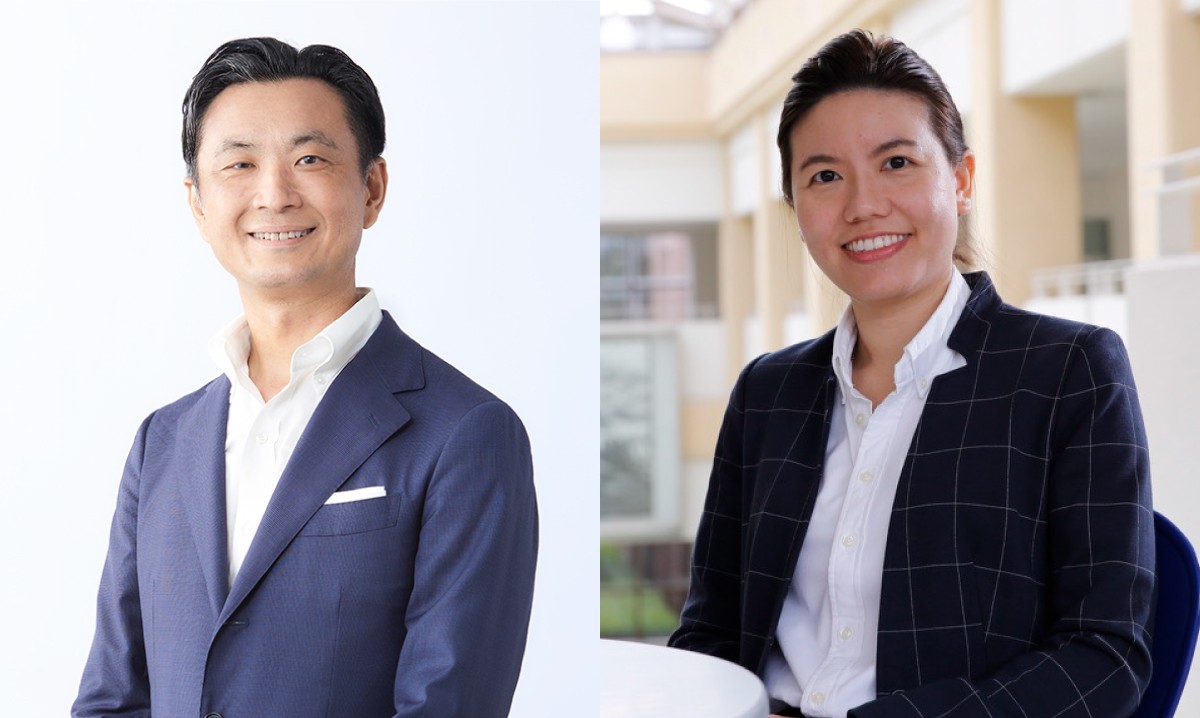
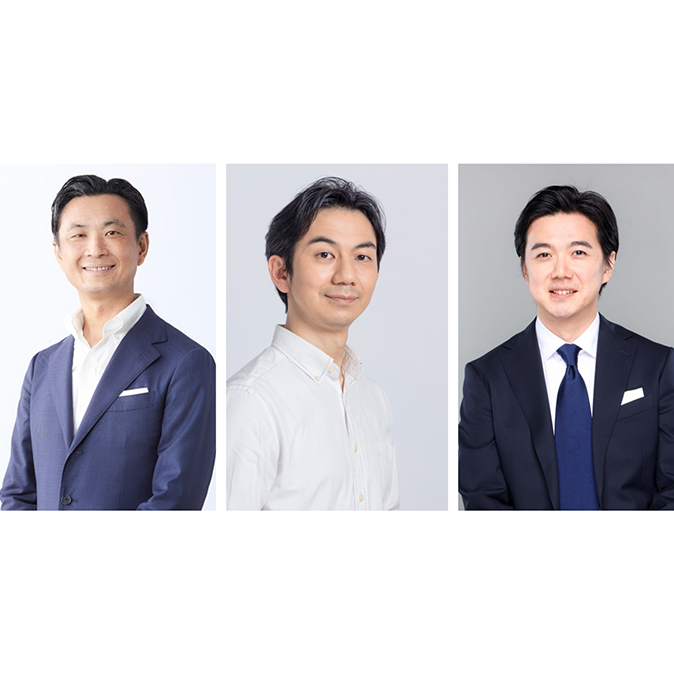
In an era where AI technology is rapidly advancing and answers are generated instantly, deep insight into human beings is once again being called for in the fields of business and education. Although seemingly in different domains, Hakuhodo Institute of Life and Living (HILL) and Ritsumeikan Asia Pacific University (APU) resonate in their perspectives toward human beings. In this special interview, Prof. Pajaree Ackaradejruangsri, Dean of Academic Affairs at APU, and Goro Hokari, Institute Director of HILL, explore the ideal image of future leaders and a new form of knowledge that transcends the boundaries of business and academia.
(Interviewer: Yuko Ito, R&D Director, HILL)
1. Looking at what AI cannot see: The shared philosophy of APU and HILL
ITO: One of HILL’s philosophies is Sei-katsu-sha Centric Mindset, and APU focuses on developing global leaders. They sound a little bit different, but what do you think they have in common about their underlying perspective toward human beings?
PAJAREE: APU is in higher education, while HILL is in business and social research, so we come from quite different fields. But I think we share the same starting point: a deep respect for people.
Before we jump to solutions, we first try to understand people, their lives, experiences, and perspectives. Today, you can open your computer or smartphone, type a prompt, and get an answer from AI almost instantly. But AI cannot replace our curiosity about people or our ability to empathize with them. So I think it is becoming even more important for educational and research institutions to look beyond quick answers and develop deeper insights into how people actually live, think, and feel.
HOKARI: Sei-katsu-sha Centric Mindset is a philosophy for creating the future by placing the happiness of people at its core. It prioritizes human happiness above all. Rather than thinking about a vague concept like benefit to society, we start with pursuing the happiness of a single individual, which eventually leads to the happiness of society as a whole and business profit.
ITO: Professor Pajaree, how do you think APU’s educational philosophy connects with HILL’s idea of pursuing individual people’s happiness or well-being?
PAJAREE: As Hokari-san mentioned, I think APU shares a very similar perspective. We often talk about the three Ps: People, Planet, and Profit, but if we go back to APU’s founding principles, especially Freedom, Peace and Humanity, there is a strong connection with the Sei-katsu-sha Centric Mindset. Both begin with people and their everyday lives and well-being.
At APU, students from more than 110 nationalities learn and live together, and we offer education in both English and Japanese. In that sense, our campus itself is almost a living laboratory for intercultural coexistence and human-centered learning.
I believe that when multicultural learning is combined with a deep understanding of individuals and their lives, we can develop global leaders who are better prepared to address complex social challenges and help shape the future of society.
2. “Common sense is nonsense”—New perspectives seen through multiculturalism
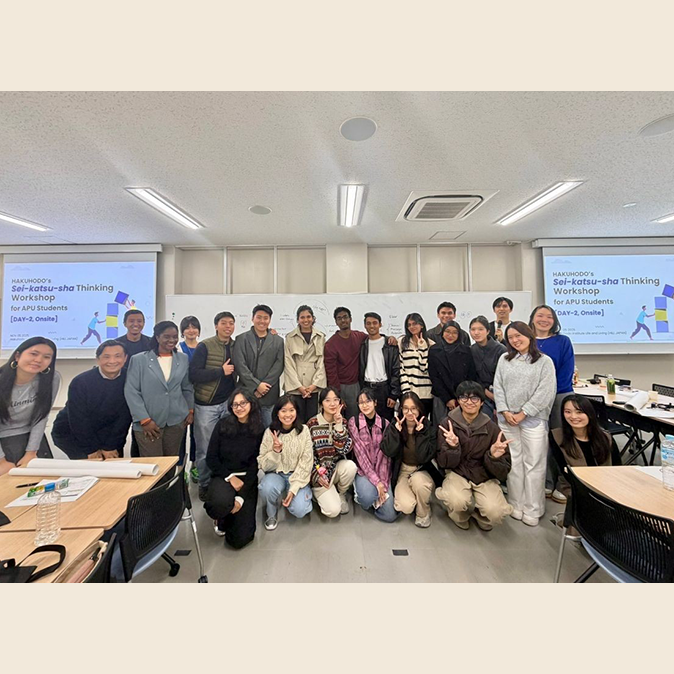
ITO: In last year’s APU project (Note 1), students generated business ideas to create win-win relationships between international tourists and the local community in Beppu. After observing students who engaged with people through fieldwork, what were your impressions of their outputs?
Note 1:In November 2025, HILL conducted a workshop for APU students. For more details, visit: https://www.hakuhodo-global.com/news/sei-katsu-sha-centric-mindset-workshop-hill-and-apu-host-co-creation-program-for-international-students.html
PAJAREE: We had around 60 undergraduate and graduate students participating both in person and online, representing 16 different nationalities.
What I found especially interesting was what happened when they stepped outside the campus and actually engaged with the local community. They began to realize that human and social issues are much more complex than they might appear from the classroom.
I was also impressed by how much they enjoyed the process of developing their proposals step by step from a sei-katsu-sha perspective, without immediately turning to AI for answers. For a generation that can easily generate ideas simply by entering a prompt, many students described this hands-on process as “eye-opening” and “refreshing.”
More importantly, it encouraged them to reflect on their own everyday behaviors and to recognize how even small actions can influence other people. That, for me, was a very powerful learning experience.
ITO: From HILL’s perspective, were there moments when you sensed newness or potential as multinational APU students practiced Sei-katsu-sha Centric Mindset?
HOKARI: Before the workshop, the student dormitory manager showed us around their living environment, and I was very impressed. She explained how students from various backgrounds solved conflicts between themselves. Not only the classroom, but their entire living space serves as a practical learning space for achieving real mutual understanding. Another big point we realized through the workshop was that “common sense is nonsense.” Common sense for Japanese locals in Beppu can be a strange thing for international students, and vice versa. They mutually realized that common sense here is not common sense in other places. To become future business leaders, learning this mindset by doing is very useful, I believe.
ITO: How do you expect incorporating such real-world observation and insight, beyond classroom learning, will contribute to cultivating APU’s vision of human capability and empathy toward others?
HOKARI: Through internal training and other programs, we also tell our practitioners not to separate business and daily life. Because the issues are in our daily life, we tell them to go out from the office and discover gaps and things that feel off in the city.
PAJAREE: For me, this is exactly what “learning by doing” means. Even in business strategy, something that works very well in Japan may not work at all in another country. So students need to learn how to read the situation, adapt as they go, and keep improving. And when something doesn’t work, that itself becomes an opportunity to learn and do better next time.
Because our students come from such diverse backgrounds, I also try not to frame classroom discussions in terms of simply “right” or “wrong.” What matters more is being able to explain why you see something in a particular way and being willing to understand why someone else may see it differently.
That is also why I prefer the idea of “mutual understanding” rather than simply “consensus.” Consensus can sometimes mean that the majority wins while the minority still feels unheard. Mutual understanding does not mean everyone has to agree. It means we understand where each person is coming from and can still find a shared direction to move forward together.
3. How understanding humans evolves marketing and education
ITO: How do you think HILL’s Sei-katsu-sha Centric Mindset approach could stimulate your academic field or APU’s educational direction?
PAJAREE: In academia, we often begin by identifying a problem, applying theories, and then moving into data collection and analysis. What I find valuable about the Sei-katsu-sha Centric Mindset is that it encourages us to take a few steps back and start with people, their everyday lives, emotions, experiences, and values.
When I teach marketing, I often guide my students to look at the “behind-the-scenes” of customers. Customers themselves may not even know exactly why they choose Brand A over Brand B. So our job is not simply to observe what they do, but to dig deeper and understand why they behave that way.
Bringing this perspective into education can help students go beyond analyzing problems only from an economic or business perspective. It encourages them to observe society more carefully, understand people more deeply, and ultimately develop solutions that truly resonate with individuals.
ITO: How might HILL’s extensive sei-katsu-sha data and proprietary insight methodologies transform new education and research in academia?
HOKARI: I believe we can offer two types of value to academia. One is our long-term chronological database on humans spanning over 30 years and the other is a borderless, interdisciplinary approach that is not bound by specific academic fields. This can also be described as a methodology-neutral stance, meaning we adopt any method, such as anthropological or psychological experimental approaches, just to understand human insights.
4. Shaping the future: Those who keep asking questions and are curious about differences
ITO: As both APU and HILL have people-centered perspectives, what new challenges do you hope to pursue together, and what changes do you expect?
HOKARI: To demonstrate how a human-centered philosophy can drive business growth, I would like to use Hakuhodo as a business case study in Professor Pajaree’s upcoming MBA lecture. Hakuhodo is a Japanese company with a 130-year history that is still growing on a global scale. I want to find out the “secret recipe” behind that.
PAJAREE: I think that would be a wonderful idea. Many of our MBA students, particularly those coming from developing and emerging economies, choose APU because they want to learn from Japan’s experience.
They recognize that models developed in Western contexts may not always translate directly to their own countries. So they are very interested in understanding the Japanese way of doing business, particularly how companies with a long history continue to evolve through continuous improvement, or Kaizen.
Using Hakuhodo as a real business case would give students an opportunity to explore these ideas in practice. I also think it could become a great example of how universities and corporate partners can work together to co-create meaningful education.
ITO: Finally, could you give a message to the students who will shape the future?
PAJAREE: I see life as a continuous journey of learning, unlearning, and relearning. The world around us keeps changing, so we should never think of ourselves as a “full glass.” We need to stay open, to question what we already know, let go of ideas that no longer work, and be willing to learn again.
I often tell my students, “Don’t simply believe everything I say in the classroom. Your job is to challenge me, and challenge yourself, with curiosity.”
And when an opportunity comes your way, have the courage to take that leap. Don’t be too afraid of making mistakes. Sometimes the moments when things do not go as planned are exactly the moments when we grow the most.
Most importantly, believe that you have the ability to make a difference. The small choices and actions you make today can already begin to transform the people and society around you.
And finally, don’t stop at asking “Why?” and “How?” Also ask “So what?” and “Why not?”
Think thoroughly about twisting common sense and making things happen.
HOKARI: I also think we should stay curious. In both your work and daily life, keep an interest and continue asking “why”: “Why does this person think this way?” or “Why am I acting this way?” It is not just about respecting the differences among people, but the power to find those differences interesting that leads to action and will make future society much richer, I believe.
ITO: “Why not?”, “So what?”, and an endless curiosity to find differences interesting. Thank you very much for giving us deep and stimulating hints for shaping the future era.
About Hakuhodo Institute of Life and Living (HILL)
Established in 1981, Hakuhodo Institute of Life and Living is a world-renowned think tank that has been instrumental in advancing Hakuhodo’s Sei-katsu-sha Centric Mindset philosophy. HILL’s work begins from the perspective that consumers are multi-dimensional, flesh-and-blood individuals rather than categories of faceless consumers.
HILL employs time-series surveys to trace changes in the values of sei-katsu-sha, adopts cutting-edge and experimental methods to uncover portents of the future and emerging trends, and goes far and wide to meet sei-katsu-sha where they live to discuss the issues relevant to them.
https://seikatsusoken.jp/english/
About Ritsumeikan Asia Pacific University
Ritsumeikan Asia Pacific University (APU) is a private university founded in 2000 in Beppu, Oita Prefecture, Japan, based on the core principles of Freedom, Peace and Humanity, International Mutual Understanding, and Shaping the Future of the Asia-Pacific Region.
International students from 118 countries and regions (as of November 1, 2025) make up approximately half of all students. In the Times Higher Education (THE) Japan University Rankings 2025, the university was ranked 2nd nationwide for International Outlook and 3rd nationwide for Teaching Quality.
Within a multicultural and multinational environment, the university provides collaborative learning and bilingual education in Japanese and English, playing a leading role in global education.
https://en.apu.ac.jp/home/