


Hakuhodo, others, conduct PoC for Human-Verified Ad Network


- News
Tokyo—October 14, 2025—Hakuhodo Inc., a leading integrated marketing and innovation company headquartered in Tokyo, is pleased to announce that the MIRAI Design Unit, its new business development arm, LG Electronics Inc., and Tools for Humanity Corporation, a key developer of the open source World protocol jointly invented by Sam Altman, Alex Blania and Max Novendstern, have conducted proof of concept for Human-Verified Ad Network as a new initiative to address the issue of ad fraud in the AI era by delivering ads to humans only.
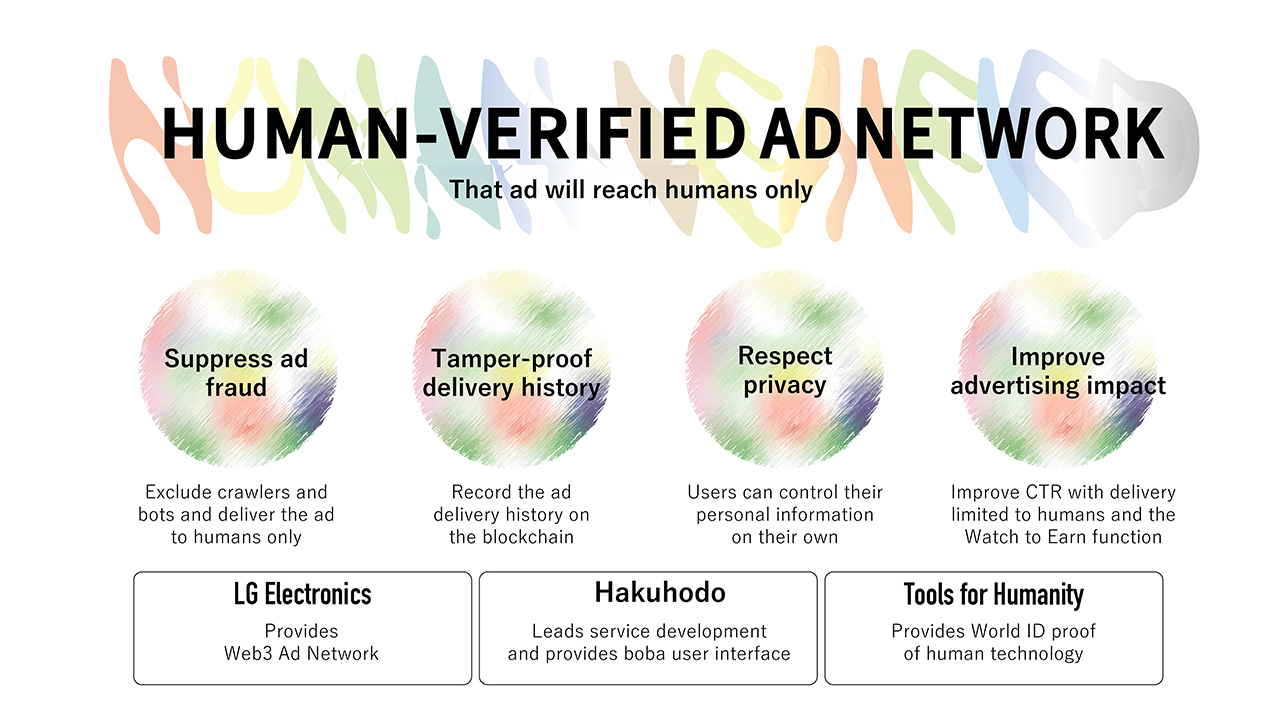
Major longstanding challenges facing the digital advertising industry include the proliferation of ad fraud, reduced targeting accuracy due to enhanced privacy regulations, and the decline in user engagement.
In this proof of concept, Hakuhodo leveraged its knowledge of the advertising business developed over many years to lead the conceptualization of the entire service to provide a solution to the fraudulent earning of advertising fees through misuse of AI and other means (ad fraud), which has become a major social issue. Specifically, we aimed to build a transparent economic ecosystem where fees are charged only for ads that are actually delivered to humans, using boba, a mini app developed by Hakuhodo, as a point of contact with users, with the support of World ID, a proof of human technology, and Web3 Ad Network, developed by LG Electronics, to record the ad delivery history on the blockchain.
We used the network to deliver in-app ads only to those who were proven to be humans (no incentive attached). The results showed improvements of some 50% in click-through rate (CTR) and some 15 points in bounce rate (Note 1) as compared with unconditional ad delivery to major Web2 ad menus. This finding attests to the effectiveness of the concept in question, which is expected to help establish new standards for reliability and effectiveness in the digital advertising industry.
Note 1: Percentage of visitors who left the website after viewing only one page without visiting another page.
Hakuhodo is committed to accelerating its efforts to commercialize the network as part of HCAI Initiative, the Hakuhodo DY Group’s Group-wide AI implementation project.
■ Major challenges facing digital advertising
・Proliferation of ad fraud
One of the most pressing issues in digital advertising is ad fraud, or fraudulent earning of advertising fees. Advertising fees may be fraudulently charged for factors such as invalid traffic or impressions created by malicious crawlers and bots. Reportedly, the ad fraud rate is 5.12% on average in Japan, and may reach up to 51.8% in some cases (Note 2). Furthermore, the development of generative AI makes it easier to refine fraudulent techniques, making it an urgent challenge for the whole industry to maintain advertising effectiveness and ensure trust. The seriousness of this problem has already become clear, as the Ministry of Internal Affairs and Communications published in the spring of 2025 its draft guidance to raise awareness thereof throughout the business community.
Note 2: Source: Spider AF, “Ad Fraud White Paper Report 2025 Annual Edition”
・Privacy regulations and reduced targeting accuracy
We have entered the phase of restrictions on the use of third-party cookies with international privacy regulations such as GDPR and CCPA, as well as the coming into force of the amended Act on the Protection of Personal Information in Japan. These regulations are expected to reduce targeting accuracy by up to 40% (Note 3). Advertisers now face the pressing issue of how to maintain the relevance of advertising and measure its effectiveness while respecting the privacy of users.
Note 3: Source: cropink, “40+ Targeted Advertising Statistics: Data-Driven Marketing Insights [2025]”
・Decline in user engagement
Users are increasingly discontented with digital advertising today, largely due to the display of ads not aligned with their interests and a sense of vigilance against the collection of personal information. For the same reasons, users may become reluctant to accept ads, eventually resulting in reduced engagement, particularly in terms of interest in advertising and CTR. This may in turn reduce the effectiveness of advertising, making it difficult for advertisers to get adequate returns on their advertising spend.
■ Details of proof of concept for Human-Verified Ad Network
To propose a new solution to the complex issues facing digital advertising, Hakuhodo, LG Electronics and Tools for Humanity conducted proof of concept for Human-Verified Ad Network.
Concept and functions
The core function of the network is to deliver ads only to users proven to be humans and record the ad display history in a tamper-proof manner by using World ID and Web3 technology. In so doing, we will establish a mechanism to ensure that advertising fees are only charged for ads displayed to humans.
・Proof of human by World ID
World ID serves as an anonymous digital passport to prove that you are human online without providing personal information. World ID, prepared and certified by a high-performance camera Orb, effectively ensures that ads are only delivered to humans, and not to bots.
・Watch to Earn
We also implemented a Watch to Earn function to increase user engagement. This mechanism provides incentives (reward points) for specific actions such as clicking on an ad. This incentive is only given to humans, too, with the history recorded on the blockchain, which means that incentivization fees will not be fraudulently charged to advertisers.
・Blockchain to ensure transparency and immutability
Based on Web3 technology, the blockchain preserves the history of ad display and the record of incentivization in a tamper-proof form. This allows advertisers to know exactly how their money is spent, substantially improving the transparency of ad delivery.
・Self-sovereign data
Users can control their personal information on their own. The provision of basic information including on gender, date of birth and residential area was made voluntary in this proof of concept. This makes it possible for advertisers to take appropriate marketing action while respecting users’ privacy.
Proof of concept period and participants
The proof of concept was conducted from July 7 to August 31, 2025, on users in Japan. Ten companies and brands participated as advertisers, in addition to more than 3,500 users. The advertisers participated from a wide range of industries including food, cosmetics, home electronics, travel and education.
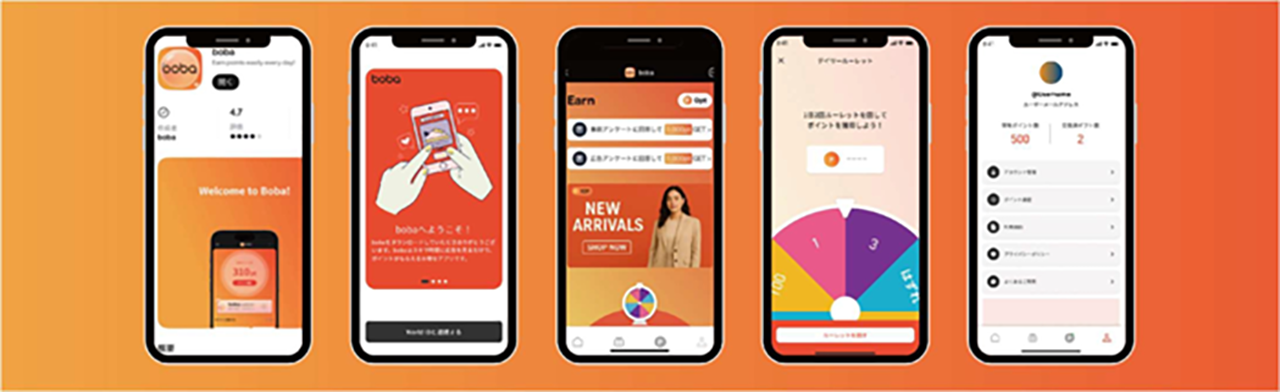
User experience procedure (with mini app boba)
For this proof of concept, we employed boba, a proprietary mini app integrating the authentication function of World ID with a reward point incentive function. Users followed the procedure below to experience the ads.
- Install World App and search for the nearest Orb: Users install World App on their smartphone or other device to obtain a World ID.
- Authenticate World ID with Orb.
- Start using the mini app boba: Activate boba in World App for linkage with World ID before registering a new account.
- Ad experience + information provision: Users can get reward points by taking action on any ad displayed on boba, such as clicking on an interesting ad or voluntarily providing basic information (age, residential area, etc.).
- Exchange of reward points for incentives: Reward points can be exchanged for eGifts.
■ Proof of concept results
・Substantial improvement in advertising effectiveness and reduction of ad fraud
Human-Verified Ad Network demonstrated a huge advantage in effectiveness over conventional Web2 advertising. We used the network to deliver in-app ads only to those who were proven to be humans (no incentive attached). The results showed improvements of some 50% in click-through rate (CTR) and some 15 points in bounce rate (Note 1) as compared with unconditional ad delivery to major Web2 ad menus.
This finding indicates that this network’s advantage in excluding bots and invalid traffic to deliver ads only to users proven to be humans has the potential to reduce wasted ad spend due to ad fraud, thereby maximizing the return on investment (ROI) to advertisers.
In terms of qualitative evaluation, positive feedback was obtained from advertisers and users participating in the proof of concept for high transparency, improved engagement and overall ad experience.
・Improved engagement with incentives
The Watch to Earn function was found to be effective in encouraging users’ active engagement with ads. Provided with incentives, users change their behavior from passive ad viewing to active engagement, thus helping raise the CTR of ads. Indeed, incentivization (of humans in boba) effectively raised CTR by a factor of seven as compared with the case of non-incentivization (of humans in boba). This is a concrete solution to the issue of users’ disinterest in digital advertising.
About LG Electronics
For the purpose of this proof of concept, LG Electronics made available its proprietary Web3 Ad Network developed by LG Electronics’dedicated blockchain research lab. This technology connects advertisers, media companies and viewers so that the latter, or the audience, may voluntarily provide information, while creating an environment for legitimate profit-sharing in the advertising industry. Thus, advertisers can benefit from highly accurate targeting and real-time result verification, whereas the audience can participate more safely, empowered to manage their own data.
LG Electronics’ blockchain lab, responsible for innovating the home electronics ecosystem and unearthing new businesses with the help of Web3 technology, has led the development of internal blockchain technology while undertaking various projects. It is currently implementing Web3 Ad Network as its core project. Its head office is located in Seoul, South Korea.
About Tools for Humanity
Tools for Humanity (TFH) is a global technology company that builds for humans in the age of AI. Incorporated by Sam Altman and Alex Blania, TFH led the initial development of World Network and currently operates World App. Tools for Humanity Corporation is headquartered in San Francisco, USA and Munich, Germany. For more details, visit: toolsforhumanity.com.


