


Hakuhodo India presents “Emerging Choices: Hakuhodo India Trends 2026”


- Events
Tokyo—October 8, 2026—Hakuhodo Inc., a leading integrated marketing and innovation company headquartered in Tokyo, is pleased to announce that Hakuhodo India has unveiled Emerging Choices: Hakuhodo India Trends 2026, the second edition of its Sei-katsu-sha Forum study.
The study examines the evolving choices of Indian sei-katsu-sha—our term for the holistic person—comparing residents of Metro cities (Delhi, Mumbai and Bengaluru) with those of Tier 2 cities (Surat, Kanpur and Vizag) to reveal where their values are diverging and where they are converging.
Drawing on Global Chronological Lifestyle Survey on Sei-katsu-sha 2026, a major work led by Hakuhodo Institute of Life and Living that covers nine countries in Asia, the study brings together quantitative research, qualitative home visits, expert interviews, and societal trend tracking to present a people- (sei-katsu-sha–) first, category-agnostic reflection of Indians and how they are actively reshaping their everyday lives across Metro cities and Tier 2* cities.
The key findings presented at the forum are summarized below. They comprise five emerging trends for 2026 and the underlying concept of DESIGNITY (Design + Identity).
Getting Rich vs. Living Rich
In comparison to last year, money has replaced love as the top desire among Indians. 43.2% cite money, followed by freedom (41.7%) and love (41.5%). Interestingly, the meaning of prosperity differs sharply by geography. Indians in Metro cities are increasingly seeking inner fulfillment through freedom, happiness, health, rest, travel and hobbies. In contrast, 58.8% of Indians in Tier 2 cities see money as essential to happiness which is 1.1 times more than those in Metro cities.
The shift reflects two distinct but equally important narratives of success: one focused on living well today, the other on building a better tomorrow.
Conscious Isolation vs. Curated Involvement
India’s social lives are also being reshaped. People are becoming more selective about how and with whom they connect. In Metro cities, Indians are actively curating communities around hobbies, fitness, professional networks, events, festivals and shared interests. In Tier 2 cities, however, a greater degree of social withdrawal is emerging. People in Metro cities want to meet others in person (32% vs. 24.8% in Tier 2 cities) and want more friends (26.7% vs. 22.7% in Tier 2 cities). The difference is especially pronounced among people in their 30s and 50s.
Age of Inheritance vs. Age of Intention
Family remains a high-stress space, yet Indians are reconnecting on more intentional terms. In Metro cities 38.9% (vs. 35.4% in Tier 2 cities) people cite personal relationships at home as a cause of stress, even as 66.7% (vs. 63% in Tier 2 cities) want to spend more time with the family. While family bonds show signs of strain in Tier 2 cities, in Metro cities people seek greater proximity, and people in Tier 2 cities increasingly value autonomy. For people in their 30s in Tier 2 cities, neighborhood stress adds another layer of pressure.
This trend shows that the emerging choice is not to reject family, but to redefine it: staying emotionally connected while creating clearer boundaries and intentional time together.
Conventional Hierarchy vs. Convenient Participation
Traditional ideas of authority are being challenged across India. 39.4% of Indians say young people are leaders of society, and there is little difference between Metro and Tier 2 city respondents. Workplaces are also becoming more receptive to younger leadership: 42.8% in Metro cities and 43.1% in Tier 2 cities say they have no aversion to working under a younger superior.
At home, however, the rules have yet to catch up with the workplace. Equal sharing of household chores, parenting and day-to-day shopping is more common in Metro (55%) than in Tier 2 cities (47%), but in both, it is women who absorb the strain created by this gap. Expected to play modern roles outside the home while fulfilling traditional ones inside it, women report markedly higher stress than men.
Traditional rules are being rewritten at work, but home has yet to catch up—and the gap between the two is where the burden falls.
Word of Mouth vs. Word of Machine
As trust in people weakens, technology and media are becoming more important sources of information and reassurance. There is a visible trust crisis, with increased belief in AI. The media is also gaining ground over friends. 79.6% of Indians say that most people cannot be trusted, with distrust higher among Tier 2 residents and women. 57% of people place more trust on information from media than from friends. At the same time, belief in AI is exceptionally high: 87.2% of Indians say they believe in AI, compared with 40.7% in Japan. Belief in AI is strong in both Metro (89%) and Tier 2 cities (85%).
From wellbeing and health to finance and online buying—humans are trusted the least by humans.
What unites the five emerging trends is a strong sense of self—the desire to shape one’s own identity. We call this DESIGNITY (Design + Identity). The desire to design one’s own identity by one’s self lies at the root of all five trends.
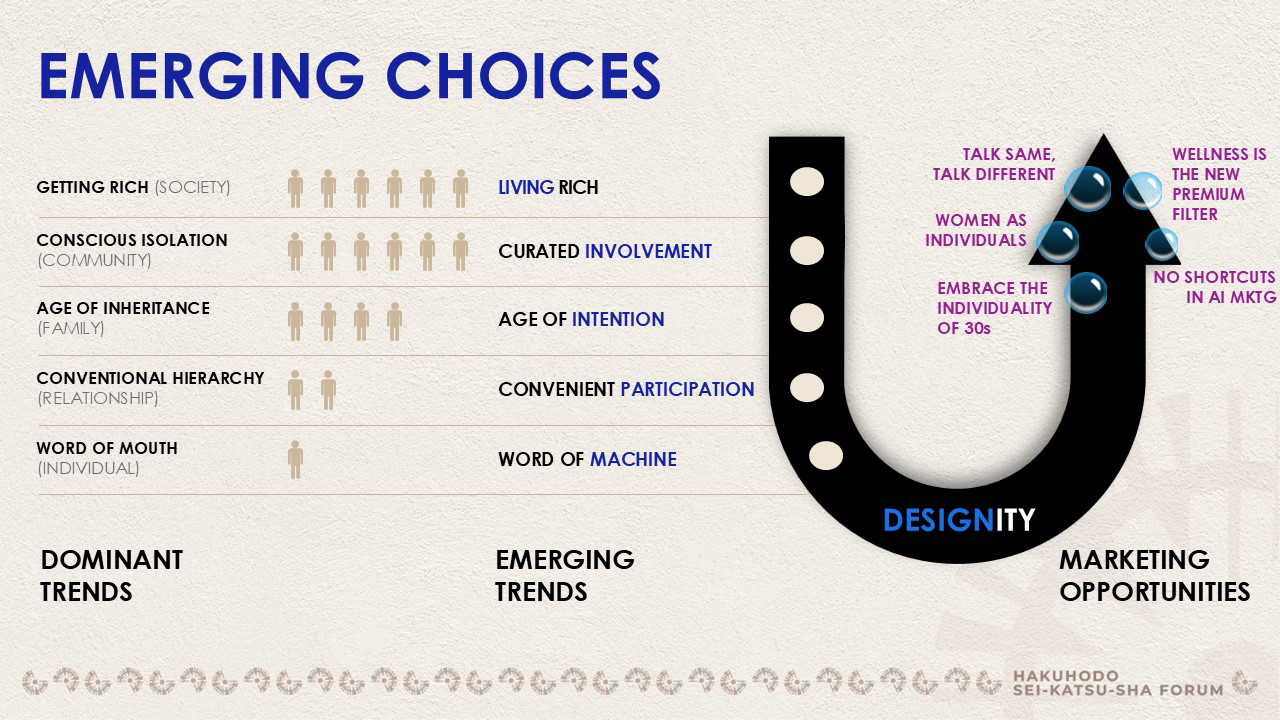
The second edition of the Sei-katsu-sha Forum brings together these shifts to offer marketers and businesses a deeper understanding of the India that is emerging—not as one homogeneous market, but as a society of increasingly intentional individuals.
* Tier 2 cities in India are officially categorized by the Government (under HRA/ Pay Commission guidelines) as Category Y urban centers.
Outline of the research
Global Chronological Lifestyle Survey on Sei-katsu-sha 2026
Methodology: Online quantitative survey
Survey area: 9 countries: India (Delhi, Mumbai, Bengaluru, Surat, Kanpur and Vizag), Japan, China, Thailand, Vietnam, Indonesia, Singapore, Philippines, Malaysia
Sample size: Global sample: 14,000, India sample: 3000
Survey period: January 2026
Home Visit Interviews
Methodology: Face-to-face interviews conducted in respondents’ homes
Survey area: India (Delhi, Mumbai, Bengaluru, Surat, Kanpur, Vizag)
Sample size: 18 (3 per city)
Survey period: June–July 2026
Expert Interviews
Methodology: Online interviews via video call
Sample size: 7
Survey period: June–July 2026
■ About Hakuhodo India
Hakuhodo India is a leading integrated marketing solutions company with four main brand agencies—Hakuhodo Sync, Hakuhodo Lync, Hakuhodo Wyng, and MA+TH Entertainment Network—and a strong network including AdGlobal360, Auburn Digital Solutions, Hakuhodo DATA LABs, Hakuhodo Digital India, Trigger Happy and PMG India. With the 11 companies and over 2000 experts, Hakuhodo India offers a full spectrum of services from marketing consulting and creative solutions to digital, experiential, content, and advanced tech and AI services. Rooted in Hakuhodo’s Sei-katsu-sha Centric Mindset, Hakuhodo India combines creativity, data and technology to drive innovation and deliver meaningful impact for brands and society. For more information, visit www.hakuhodoindia.com


